
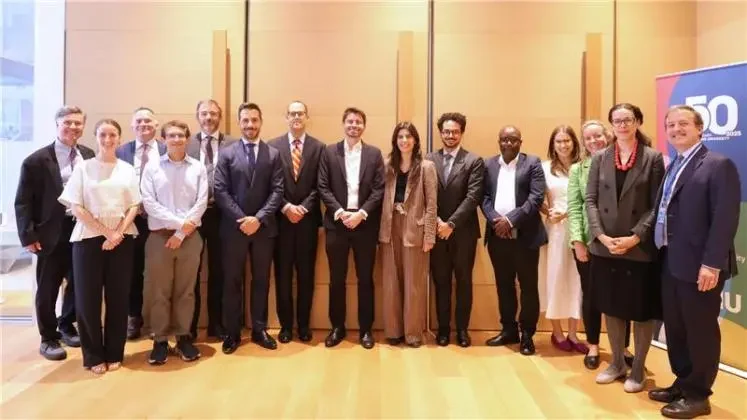
Convened by the United Nations University Centre for Policy Research (UNU-CPR), with support from the Governments of Brazil and Germany, the British Academy, the Bahaï International Community’s UN Office, BMZ, and the International Development Research Centre of Canada (IDRC), this Chatham House workshop brought together experts, diplomats, and practitioners to examine the future of global climate governance.
While the multilateral climate regime has delivered vital progress, implementation remains dangerously out of sync with scientific consensus and government commitments. Current patterns of investment, consumption, and political decision-making are reinforcing the status quo, widening the gap between climate ambition and action.
The workshop followed a high-level dialogue convened on 1 May 2025 by UNU-CPR, responding to President Lula’s G20 call for a UN Climate Change Council and reflections by COP30 President Ambassador Andre Correa do Lago. Ambassador do Lago highlighted the concept of a global mutirao coordinated collective effort to accelerate more agile, coherent and collaborative climate governance while reinforcing the central role of the UNFCCC.
This follow-up session allowed participants to delve deeper into governance challenges and opportunities introduced during the May dialogue. Rather than defining specific institutional designs, participants tested ideas, surfaced cross-cutting themes, and identified points of convergence and tension across proposals. Brazil’s framing and the application of complexity science informed a shared vocabulary for evaluating the political and technical feasibility of reforms.
Discussions were structured around three themes:
- Software: ideas and approaches
- Hardware: rules and institutions
- Politics: trade-offs and coalition-building
Three synthesis papers will capture insights from written submissions and workshop dialogue, to be shared with the broader community in the lead-up to COP30 and published as part of a special feature in Global Governance, the journal of the Academic Council on the United Nations System (ACUNS).