
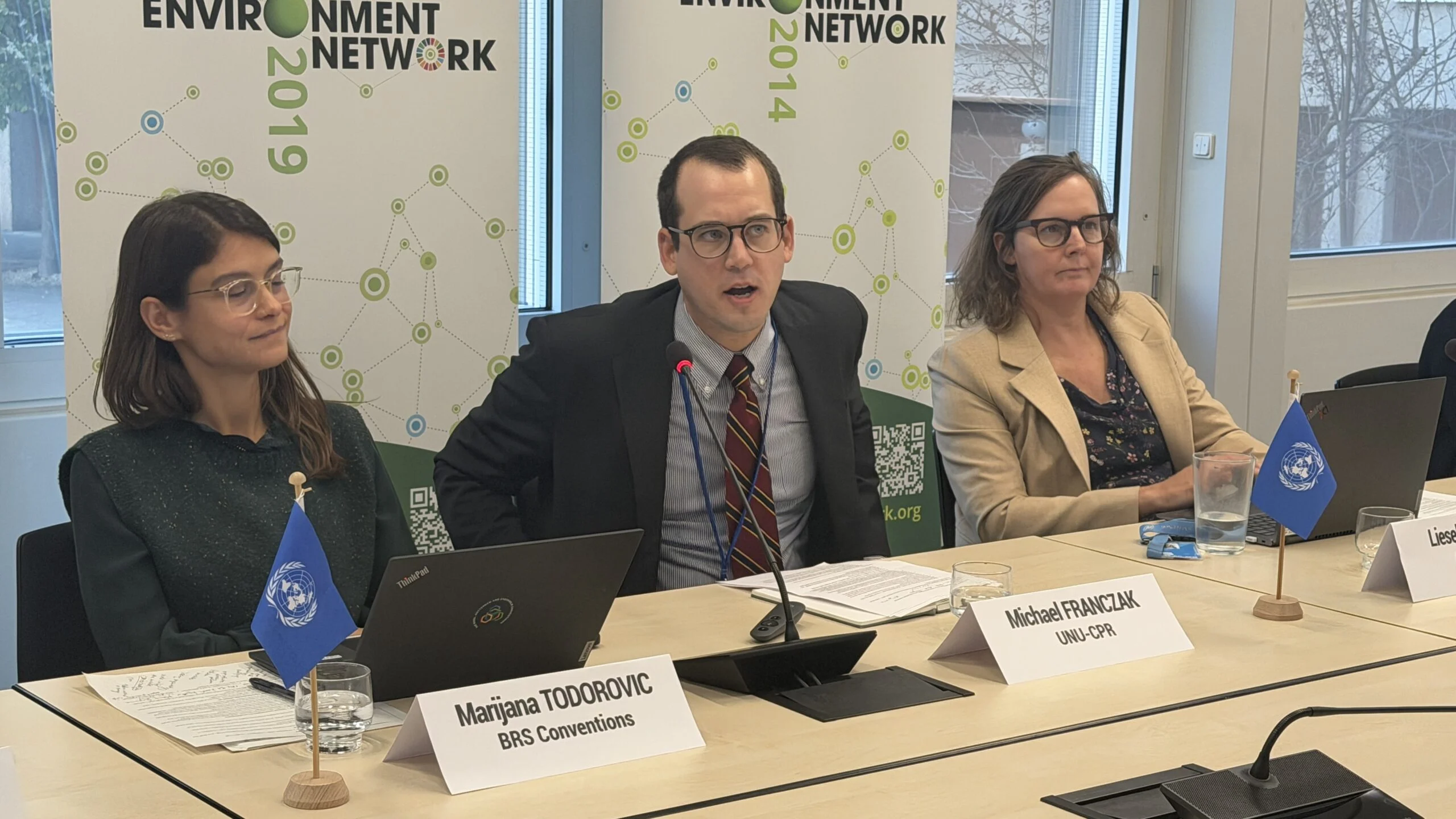
Dr. Michael Franczak, Senior Researcher at UNU-CPR and lead of the Global Governance Innovation (GGI) Platform’s Hub for Innovative Resource Mobilization, spoke at “Rethinking UN Financing in the UN80 Context: A Spotlight on Pollution.” The event took place at the International Environment House in Geneva and online. It was convened by the Secretariat of the Basel, Rotterdam and Stockholm (BRS) Conventions and UNU-CPR, in collaboration with the Geneva Environment Network.
The session brought the UN-wide discussion on innovative resource mobilization (IRM) to International Geneva. Speakers explored the opportunities and challenges of applying innovative financing to UN mandates, with a focus on environmental protection and pollution management.
Dr. Franczak opened by setting out the scale of the problem. Official development assistance has fallen sharply. The UN now faces less core funding, a higher share of earmarked funds, and growing demands on its work.
His core argument was that innovative financing cannot replace core contributions from Member States. But the UN can better use its existing resources, build new partnerships, and scale successful approaches across institutions. Drawing on GGI research, he outlined six pathways for doing so:
- New contributors, such as the private sector, institutional investors, cities and foundations
- New contributions, such as levies, fees, guarantees, bonds and advance commitments
- New uses of the UN’s comparative advantage, including standards, registries, data and convening
- New partnerships, especially between the UN and multilateral development banks
- New sources of economic value through specialized services and market functions
- New economic tools that help beneficiaries reduce future costs
He noted that the UN is already innovating, but often in isolation. Examples include UN-Habitat’s Cities Investment Facility, IFAD’s entry into bond markets, and UNICEF’s investments in digital public goods. GGI’s role is to identify which approaches can be adapted and scaled, and under what conditions.
To address this fragmentation, GGI has established the Hub for Innovative Resource Mobilization. The Hub brings together practitioners from across the UN system on a monthly basis to examine emerging financing modalities, exchange lessons from implementation, and identify approaches with potential for wider application. In doing so, it aims to ensure that innovations developed in one entity can inform and strengthen the work of others.
Dr. Franczak also set out the limits. Few financial innovations transfer easily between entities. All require enabling political, economic, and legal conditions. All require investment in money, time and people.
He closed by urging participants to ask new questions. What resources is the UN leaving on the table? Where can it reduce risk for other capital? Where can one entity’s innovation become another’s solution?
Other speakers shared concrete cases. Frank Moser of the BRS Secretariat presented the Transforming to Cleaner and Greener Strategy, which treats the phase-out of PCB equipment as an investment in electricity grids. Pilar Pedrinelli of UNHCR presented the Refugee Environmental Protection Fund, which links reforestation and clean cooking in refugee-hosting areas to carbon markets. Rolph Payet (BRS Conventions), Liesel van Ast (UNEP Finance Initiative) and Lucretia Landmann (Swiss Federal Office for the Environment) also spoke. Marijana Todorovic (BRS Secretariat) moderated.
Further reading
- UNU-CPR report: Moving from Crisis Management to Resource Mobilization in the UN80 Process
- Blog by GGI Director Dr. David Passarelli and Dr. Michael Franczak: The UN is reinventing its finances — and it’s a better bet than you think
Watch the Recording
The presentation from the event is available here.